



Introduction: A Duty That Belongs to Every Member of Staff
When it comes to safeguarding, most teachers feel confident with the basics — knowing who the DSL is, understanding what a child protection referral looks like, following the school's policies. But the Prevent duty is one area where uncertainty is common, confusion is widespread, and the stakes for getting it wrong are real.
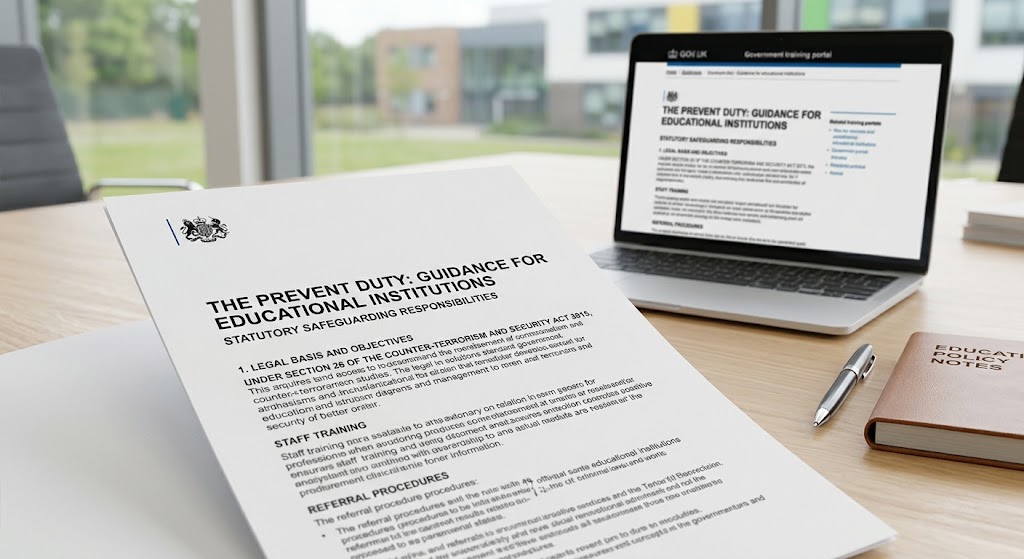
Since July 2015, every school in England and Wales has had a legal duty under Section 26 of the Counter-Terrorism and Security Act 2015 to have due regard to the need to prevent people from being drawn into terrorism. That duty has not changed — but the guidance supporting it has been updated, and the DfE has recently published new resources specifically to help Designated Safeguarding Leads and school staff understand their responsibilities.
This article explains what the Prevent duty actually means in practice — cutting through the misconceptions, setting out the warning signs, and making sure you know what to do if you have a concern about a young person.
The Legal Basis: Plain English
The Prevent duty is part of the UK government's broader CONTEST counter-terrorism strategy, which sits alongside three other strands: Pursue, Protect, and Prepare.
For schools, the duty sits alongside your existing safeguarding responsibilities. It is not a separate, standalone obligation — it is baked into the same framework under which you already operate. Just as you have a duty to protect young people from abuse, exploitation, and neglect, you also have a duty to protect them from the risk of radicalisation.
The statutory Prevent Duty Guidance (issued September 2023, in force from December 2023) sets out three core objectives for education settings:
- Respond to the ideological challenge of terrorism by challenging narratives that promote extremism.
- Prevent people from being drawn into terrorism through early intervention and support.
- Work with key sectors — schools, local authorities, police, health — to address radicalisation risks together.
Importantly: there are no mandatory reporting requirements under the Prevent duty. You are not required to report every concern to the police. What you are required to do is follow your school's safeguarding procedures — which means telling your DSL.
Key Definitions: What Do These Terms Actually Mean?
These words get thrown around a lot — often interchangeably, and often inaccurately. Here is what they actually mean in a school context.
- Extremism: The vocal or active opposition to fundamental British values, including democracy, the rule of law, individual liberty, and mutual respect and tolerance of those with different faiths and beliefs.
- Radicalisation: The process by which a person comes to legitimise support for, or use of, terrorist violence. It is a process — not a single moment.
- Terrorism: An action that endangers or causes serious violence to a person; causes serious damage to property; or seriously interferes with an electronic system — intended to advance a political, religious, or ideological cause.
Radicalisation rarely happens overnight. It is a gradual process, often exploiting existing vulnerabilities — social isolation, a sense of injustice, identity confusion, mental health difficulties, or exposure to extremist content online.
What You Are Looking For: Signs That a Young Person May Be Vulnerable
There is no single profile of a young person at risk of radicalisation, and the government is explicit that Prevent should not be applied in a discriminatory or profiling-based way.
What you are looking for are changes in behaviour — the same instinct you use as a teacher to notice when something is off. Some indicators that may suggest vulnerability include:
Changes in views and expression:
- Expressing sympathy for extremist groups or their narratives
- Justifying violence as a solution to political or social grievances
- Using language or terminology associated with extremist ideologies
- Seeking to impose views on others or becoming increasingly intolerant of difference
Changes in behaviour:
- Sudden or marked withdrawal from friends and activities
- Accessing or sharing extremist content online
- Becoming defensive or secretive about online activity
- A significant change in attitude towards authority or institutions
Contextual vulnerabilities:
- Experiencing bullying, exclusion, or a sense of not belonging
- A family member or peer involved with extremism
- Recent bereavement, trauma, or family breakdown
- Grievances about UK foreign policy, specific communities, or perceived injustices
These factors do not automatically mean a young person is being radicalised — they are indicators that might prompt a conversation with your DSL.

Common Misconceptions About Prevent
Prevent is one of the most misunderstood aspects of safeguarding in schools. Here are the most common myths — and the reality.
- Myth: Prevent means I have to spy on students. Reality: Prevent is about supporting vulnerable young people, not surveillance. It is comparable to other safeguarding processes protecting children from gangs, substance misuse, or exploitation.
- Myth: Prevent only applies to Islamic extremism. Reality: The Channel programme addresses all forms of terrorism and extremism — including far-right, neo-Nazi, mixed ideologies, incel-related extremism, and others.
- Myth: A Prevent referral gives a child a criminal record. Reality: Channel is a voluntary, confidential support programme — not a criminal sanction. A referral will not appear on a young person's record.
- Myth: Only teachers in high-risk areas need to worry about this. Reality: The duty applies to every school in England and Wales regardless of location, demographic, or type. Every staff member should have at least a basic awareness.

What to Do If You Have a Concern
The process for acting on a Prevent concern follows the same pathway as any other safeguarding concern.
- Do not confront the young person directly or challenge their views in isolation — this can backfire and shut down communication.
- Note what you have observed — specific behaviours, language, or incidents, with dates and context.
- Tell your DSL as soon as possible. They are responsible for deciding next steps, including whether to make a Prevent referral.
- The DSL may refer to Channel — the government's multi-agency early intervention programme for individuals identified as vulnerable to radicalisation.
How Channel Works
Channel is led by the local authority and brings together police, education, health, and social care professionals. The process has three stages:
- Identify whether the individual shows genuine vulnerability to extremism.
- Assess the nature and extent of that risk.
- Develop a tailored support plan — which might include mentoring, mental health support, educational assistance, or family support.
Participation is entirely voluntary. A referral to Channel does not mean a young person is a terrorist suspect — it means they are being offered support.
British Values: How Prevent and Classroom Teaching Connect
One of the most practical and positive parts of the Prevent duty is the requirement to promote Fundamental British Values — not as a political exercise, but as a way of building resilience to extremist narratives.
Since September 2015, all Ofsted-registered schools must actively promote:
- Democracy — understanding how decisions are made collectively, respecting different views
- The rule of law — understanding that laws protect everyone and apply equally
- Individual liberty — respecting the right of others to make their own choices
- Mutual respect and tolerance — of those with different faiths, beliefs, and backgrounds
This does not require a dedicated British Values lesson. It should be woven into PSHE, RE, English, history, and everyday classroom culture. When young people have strong critical thinking skills and a sense of belonging, they are more resilient to extremist messaging.

Your Role vs. the DSL's Role
Your responsibility under Prevent is to be aware, to notice, and to report — not to investigate, intervene, or counsel.
Your role as a teacher or TA:
- Notice changes in behaviour or expression
- Record observations accurately
- Report to DSL promptly8 minutes
- Continue offering a warm, consistent relationship
- Promote British Values in everyday teaching
The DSL's role:
- Receive and assess concerns
- Decide whether to refer to Channel
- Liaise with police, local authority, Channel
- Manage information-sharing with parents
- Lead Prevent training and policy review
If you are ever unsure, the rule is simple: tell your DSL. You do not need to be certain — you just need to have a concern.
Frequently Asked Questions
Is there mandatory reporting under the Prevent duty?
No. There are no mandatory reporting requirements. You should follow your school's safeguarding procedures, which means referring concerns to your DSL.
Does Prevent apply to primary schools?
Yes. The duty applies to all schools, including primary schools and early years settings. The approach and context will differ, but the legal obligation is the same.
What if I make a referral and I turn out to be wrong?
A well-intentioned, properly documented referral made in good faith is always the right thing to do. You are not expected to be certain. The Channel assessment process exists precisely to determine whether a concern is genuine.
What training am I entitled to?
Schools are expected to ensure all staff have Prevent awareness training. The Home Office's WRAP (Workshop to Raise Awareness of Prevent) training product is the most widely used tool for this purpose.
Build Your Prevent Awareness With Free CPD
The Prevent duty sits firmly within your wider safeguarding responsibilities — and like all safeguarding knowledge, it needs to be kept current.
TeachHQ's free CPD course on Prevent Agenda Awareness is built for teachers, TAs, and school support staff. It covers the legal framework, what to look for, and what to do if you have a concern, in plain language with no jargon.
You may also find these free TeachHQ courses relevant:
- Child Neglect Awareness — understanding vulnerabilities across safeguarding contexts
- Bullying and Harassment in Education — recognising the social factors that can increase vulnerability
All courses are free. Certificated. No payment card required. Safeguarding, Prevent Duty, Radicalisation, Teacher CPDCreate your free TeachHQ account and start your Prevent CPD today.